Posts

Showing posts with the label Religion

Jesus Did Not Die For Your "Sins"

Image
One of the most common misconceptions in modern Christianity is the belief that Jesus Christ sacrificed himself to absolve all of mankind's sins. In fact, nowhere in the Bible does it even say this. While a few broad elements of it are true, the overall notion is far from what fully transpired - and what the long-term effects really were. Most western churches do not preach this, but any Christian who is concerned with their spiritual well-being and afterlife should try to understand what exactly it was that Jesus was trying to achieve. Christians know the basic story: Jesus Christ, the son of God, was captured and hung on a cross for crucifixion. While he was up there, he took on all the sins of the world, which upset God but it freed everyone from sin. And then three days later on Easter morning he rose from the dead like nothing happened. Again, certain elements of that story are true, while others....are a bit stretched. But many details are left out when this story is being ta...

Latter-Day Saints: How Mormonism Rocked the Christian World

Image
Most people in America have heard of The Church of Jesus Christ of Latter-Day Saints, or Mormons (informally). Some of you reading this may be members of the Church. Or you may have seen the missionaries helping in the community or going door to door in your neighborhood for a chance to speak to people about their church. Unfortunately the LDS are often on the receiving end of jokes, or treated poorly when they approach someone. Some of this is due to society's increasing departure from religion, but a lot more of it is due to the fact that people really don't understand who the Mormons are or what they believe. The Origin of Mormonism Early Years The roots of Mormonism began in 1820 in New York state near the town of Palmyra, about 25 miles east of Rochester. The account goes that 14 year old Joseph Smith, Jr. was contemplating his life, and more specifically his place in the church. He didn't agree with all of the competing Christian denominations, and felt that none of t...

Buddhism: The Religion Without a God

Image
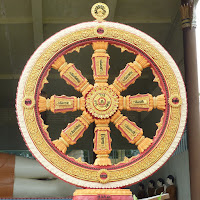
Buddhism is one of the world's largest religions, with over 500 million followers. Buddhism is non-theistic, meaning there is no belief in a god, and can be considered a philosophy as much as a religion. Starting in ancient India, it spread through much of Asia within a few hundred years. Buddhism has since split into several different schools of thought, but the core principles remain the same throughout all denominations. Overall Buddhism is a peaceful compassionate belief system that seeks to end the pain and suffering of life through learning to let go and find tranquility within. History of Buddhism Buddhism began around the 5th century BCE in India. Its founder was a prince or nobleman from near the India-Nepal border named Siddhartha Gautama. Growing up in a rich lifestyle, he was sheltered by his father because of a prophecy that stated if Gautama went into the outside world and witnessed four specific signs, he would not grow to be a King but a great religious leader. As a...

There's Too Much Christ in Christianity

Image
The problem with Christianity is there's too much focus on Jesus Christ. That may sound like a funny statement because his name is right in it, but that's because the religion was supposed to about what he was teaching, not the man himself. Jesus wasn't out trying to start a whole new belief system, he wasn't trying to get people to pray to his cross or make statues of his mother. He was out spreading and reinforcing the ideals of Judaism. Jesus was raised in a strong Jewish household, surrounded by family who was very religious. He picked up on it quickly, naturally, and at a young age could be found at the Temple arguing with the Rabbis, testing their knowledge and faith. As he got older and began realizing his purpose, he began travelling to other areas to teach and support the religion of Abraham. He did modernize some of the older practices, gave alternatives to others, but at the core still maintained all of the fundamentals of the Jewish religion, as well as cont...